Hans Hofmann
For Hans Hofmann, painting was an exercise in creating relationships, an opportunity to see colors and shapes react to one another—often dramatically, in formal wrestling matches that create a dynamic sense of space.
Never planning his paintings ahead of time, Hofmann made intuitive decisions on the canvas, allowing the process to take him somewhere unknown. The term he used for moving forms backwards and forwards, expanding and contracting space, was “push/pull.” The artist’s current exhibition at the Yale University Art Gallery is a chance to see this push/pull in action and consider a life devoted to constant change and curiosity.
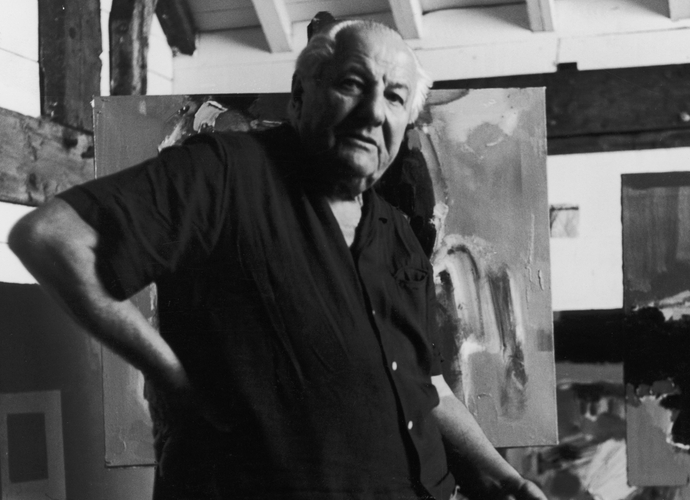
As a young man, Hofmann lived in Paris during the Fauvist and Cubist moments, where he was deeply influenced by Henri Matisse’s expressive use of color and Cubism’s architectural approach to space. A German national, Hofmann could not remain in France during World War I and returned to Munich. It was there that the artist began teaching and established his first art school. In 1932, Hofmann fled Nazi Germany for the United States, where he founded his now infamous schools in New York City and Provincetown, Massachusetts. The influence of these schools was staggering. Indeed, Hofmann’s pedagogy and work were touchstones for artists and scholars ranging from Clement Greenberg and Jackson Pollock to Nell Blaine and Robert De Niro, Sr.
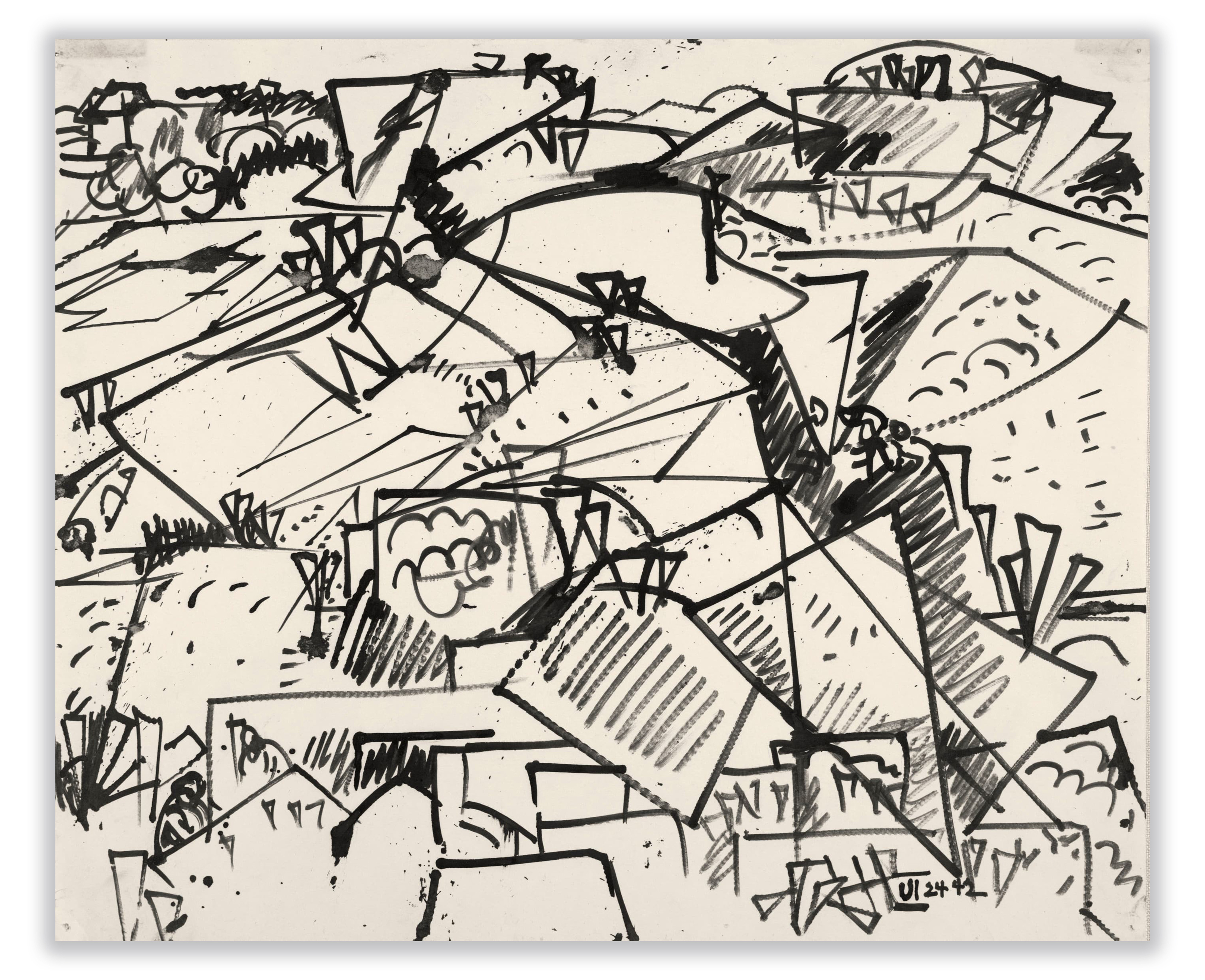
Provincetown, 1942. Black ink, 14 × 17 inches.
Courtesy Yale University Art Gallery.
Photo: With permission of the Renate, Hans & Maria Hofmann Trust/Artists Rights Society (ARS), New York.
Hofmann was enamored with the seaside town of Provincetown and drew constantly from its landscape.
Provincetown (1942), an ink drawing on paper, is representative of many works from this time. The drawing is abstract and open, with visible hints of rooftops and trees. There is a sense of flying over the town but also moving through it, like a kite, at once constructed and in flight. Despite being a black-and-white image, the drawing has a fantastic sense of light and color. An important lesson Hofmann taught his students is that with the right arrangement, black-and-white compositions can create just as much color as a full palette—or perhaps even more.
In The Pond (1958), the real action is taking place on the periphery, in an accumulation of vivid brushstrokes at upper right and a deep black passage at lower left. In the painting’s center is a loose biomorphic shape in greenish chromium oxide. It’s not the most attractive color, but the pond-like shape is distinct. Its flatness and matte finish present a stark contrast to the surrounding brushwork. Each forms the other. Where is this green shape in space? Does it wiggle its way forward towards the picture plane? Or does it recede behind the active brushwork? Hofmann reveled in creating such spatial contradictions.
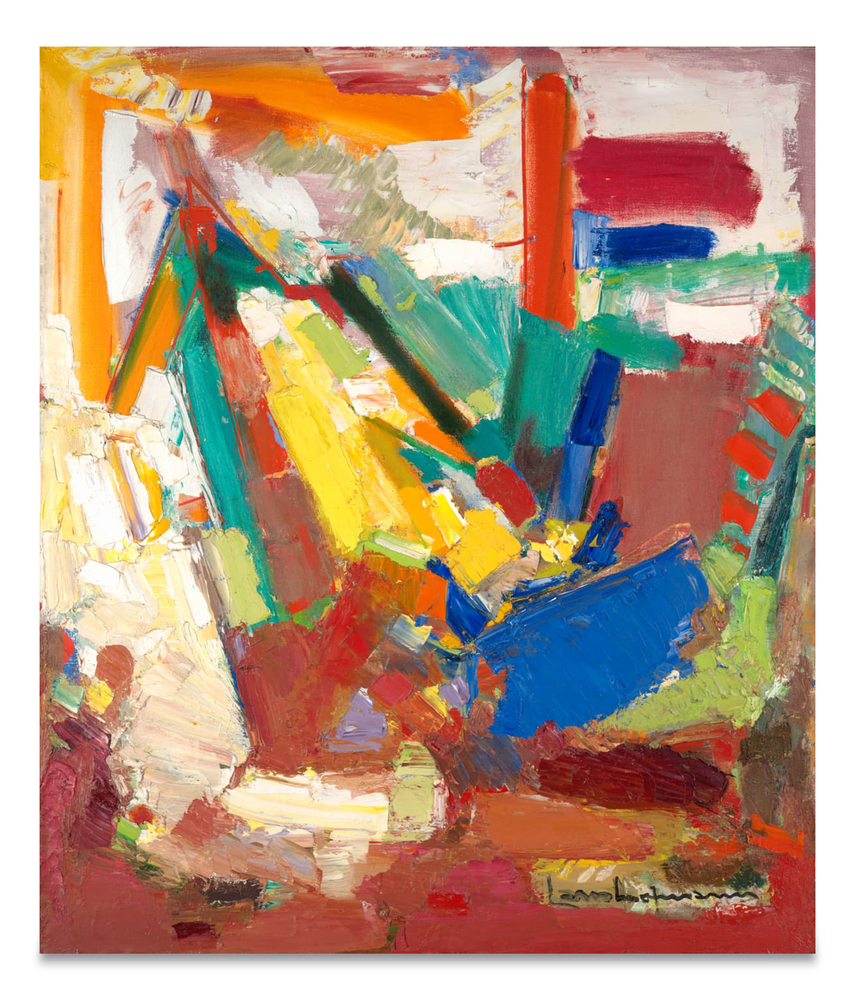
Fortissimo, 1956. Oil on canvas, 60 × 52 inches.
Courtesy Yale University Art Gallery.
Photo: With permission of the Renate, Hans & Maria Hofmann Trust/Artists Rights Society (ARS), New York.
Noticeably absent from this exhibition are Hofmann’s “Slab” paintings, which include blocks of rectilinear color often set against areas of gestural handling. But in Fortissimo (1956), one can see the gradual emergence of these slabs in its thick planes of paint applied abundantly with a palette knife. The surface is heavy, active, and rhythmically stunning. Perhaps more than any other painting in this show, here you can see the joy Hofmann took in mixing paint directly on the canvas. Mixing color this way is dicey because hues can easily mix together and turn into a muddy brown, thus collapsing space and extinguishing light. I was stunned to see how close Hofmann comes to making mud, but he never does. Instead he reveals the painting’s plasticity.
The exhibition begins and ends with Art like Love is Dedication (1965), created one year before the artist’s death. It is a wistful painting with a palpable tension between weightlessness and gravity. The forms feel suspended, with soft edges surrounded by a gray expanse, but the painting is anchored by strong colors planted decisively. In the center is a loose cluster of broad brushstrokes, mainly green, blue, and red. The colors glide gently to the left as if about to fall out of the painting, but a vertical blue stripe pinned against the edge holds the composition in place. My favorite passage is several orange patches that float on the painting’s surface and capture our gaze. Without these crucial flickers of warmth, the painting would go flat. It is not any one thing that locks this painting in place, but rather a simple play of contrasts: thin against thick, reserve against vibrancy.
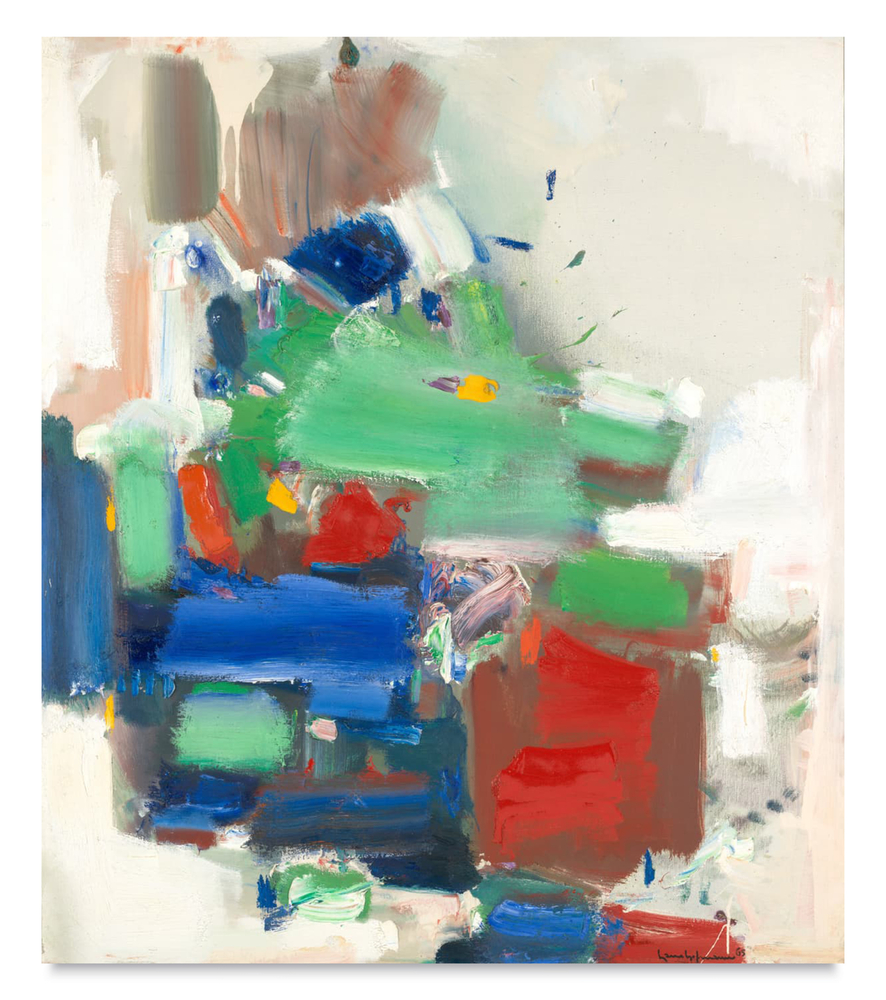
Art Like Love Is Dedication, 1965. Oil on canvas, 60 1/8 × 52 inches.
Courtesy Yale University Art Gallery. Photo: With permission of the
Renate, Hans & Maria Hofmann Trust/Artists Rights
Society (ARS), New York.
As children we have an innate sense of play, less inhibited and more willing to experiment and make mistakes. For some reason, as we age we play less, maybe for fear of failure or of losing our composure. Few artists manage to retain this sense of play throughout their lives more vividly than Hans Hofmann. I find it inspiring how Hofmann loosened the reins on painting without losing control completely. His career as a teacher also made him a lifelong student of painting. The artist was constantly questioning, trying new alternatives and daring to exhaust variation. Without a set path, painting for Hofmann became a tool of revelation, an inexhaustible space for learning.
Days after seeing the exhibition I was reflecting on Hofmann’s decision to flee Nazi Germany and seek refuge in the United States. He would never have been able to make such experimental and jubilant artwork under the Nazi regime. Hofmann blossomed in America—he came here to find a place where he could play, with total artistic freedom. Today, in a country that feels increasingly authoritarian and hostile, Hofmann’s work and teaching, which both celebrated difference and possibility, feel all the more precious.
David Whelan —