April Gornik
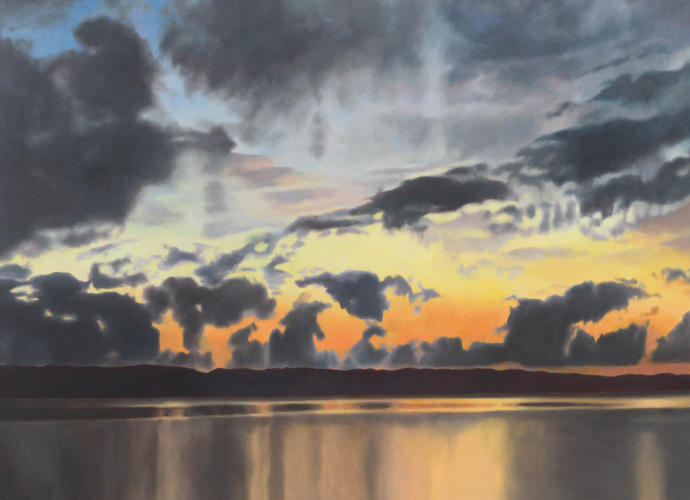
April Gornik, Spectral Lights (for Neko Case), 2025,
Oil on linen, 23 3/4 x 38 inches.
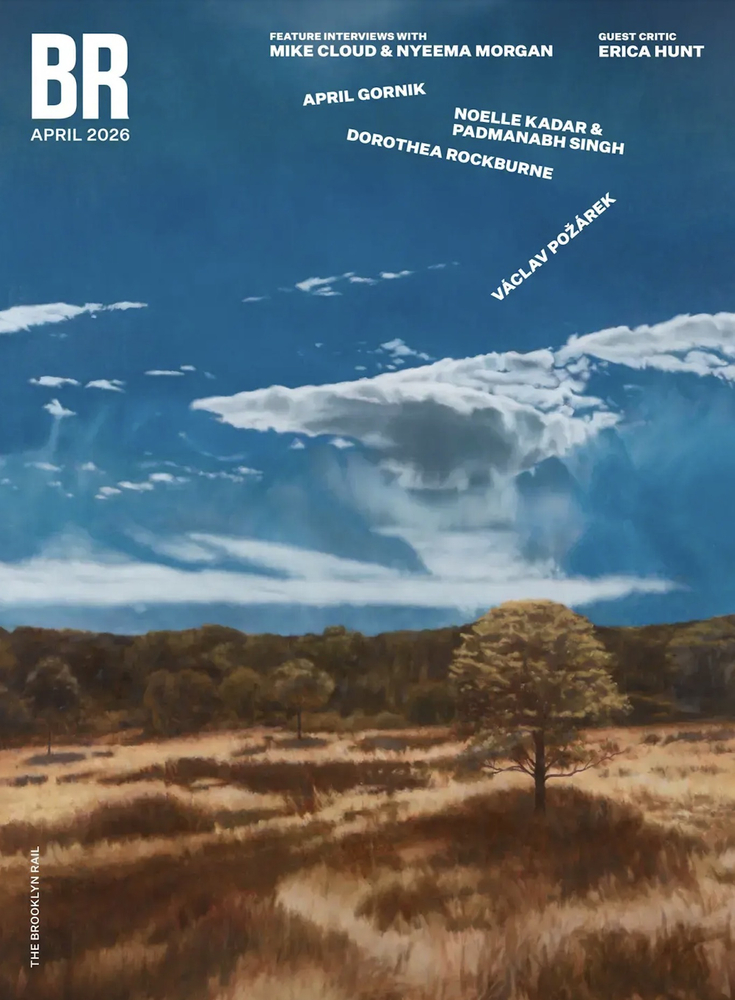
The Brooklyn Rail, Print Edition, 2026.
Hearne Pardee talks with painter April Gornik about her latest show at Miles McEnery Gallery. It’s her third solo show with the gallery, and one of many she’s had in New York since moving to the city in 1978. Under the title Liminal States, her new work generates clouds and skies that viscerally engage viewers in cosmic turning points—an eclipse or the Annunciation—rooted intuitively in the scale of her body. Alluding to poetry, music, and the work of other painters, she increasingly features light as an animating and expressive force. For this conversation Gornik met Pardee on Zoom from her studio in Sag Harbor, where she is a longtime community activist for the environment, historic preservation, and most recently co-founded The Church, a broad spectrum arts and creativity center, with her husband Eric Fischl. This interview delves into the embodied experience of her luminous images.
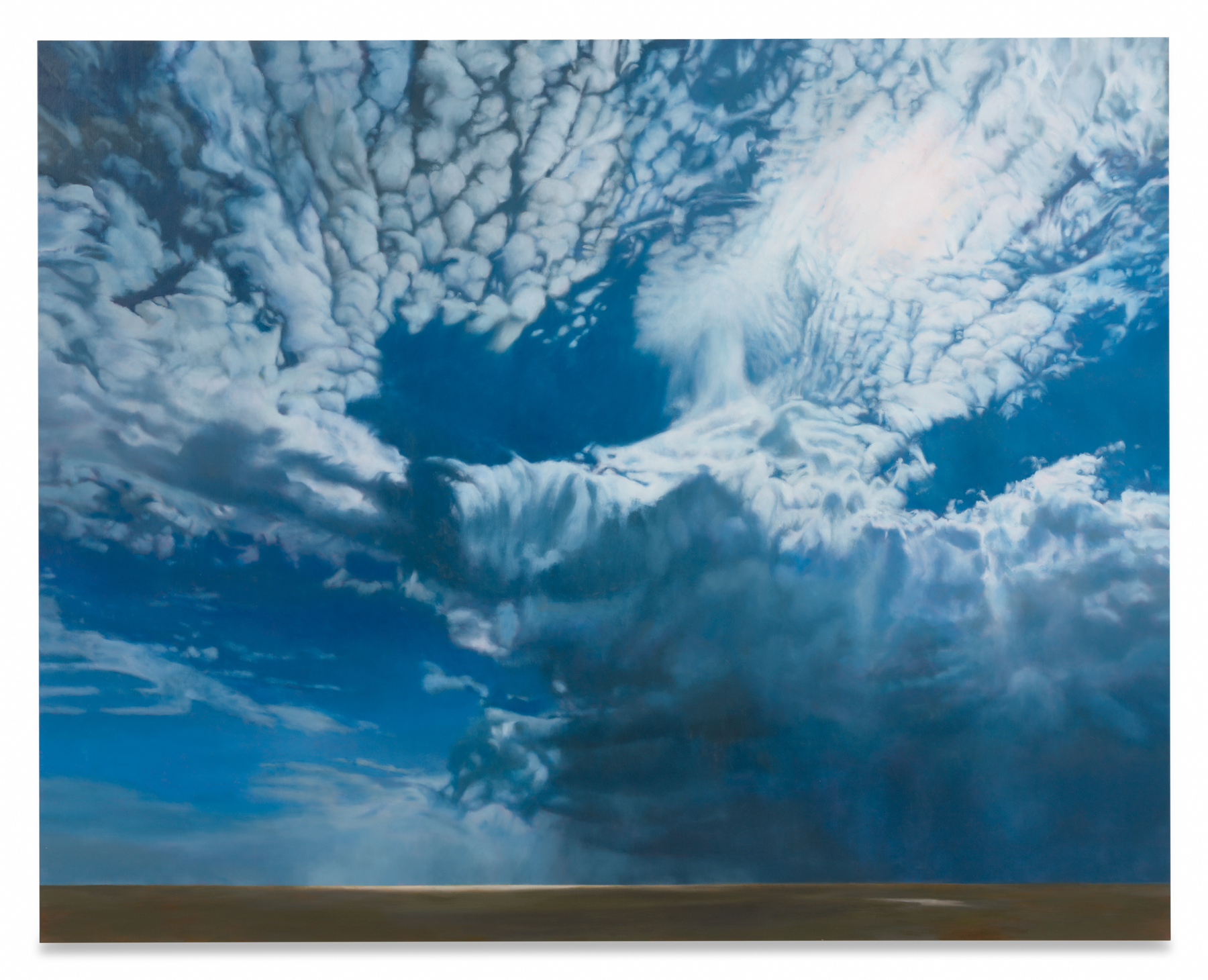
April Gornik, World of Light (for GMH), 2026, Oil on linen,
75 ¼ × 94 inches.
Hearne Pardee (Rail): So, April, you arrived in New York after studying art in Nova Scotia. What was it like to study art there in the 1970s, and how did it prepare you for life in the big city?
April Gornik: Well, the Nova Scotia College of Art and Design had a reputation for being more advanced and more interesting than my college, the Cleveland Institute of Art. I was in my fourth year there—CIA was a five-year BFA—and I was getting very antsy. I wanted to make conceptual art and generally be more experimental. So when I read an article in Art in America called, “The Best Art School in North America?” of course I thought, “I have to go there!” and I impulsively transferred.
So for the last year of my BFA, I got to take a Marxism course and talked semiotics and majored in “studio.” Nobody in their right mind was painting at that point, and I was really happy. And then midway through the year, I started to feel seriously empty. I started being more internally experimental. I stayed another year in Nova Scotia, and after graduation and a trip to Europe I began making landscapes, to my surprise.
Rail: You spoke with Lawrence Weschler about an idea that included sticks with light on them?
Gornik: I was working alone in a studio I’d rented, and I had drifted to a place where I was trying to make work that had something to do with light. I started wondering how I could make something with light in it—without for a second thinking of the whole history of painting. [Laughter] The image that popped into my head, uninvited, is what I described to Ren Weschler: it was basically a bunch of stylized reeds, backlit against water. I made it from pieces of wood I glued together in a kind of fever dream of inspiration, and then realized that it was just basically a landscape. And I was like, “Oh god, landscape, of all things”—but secretly I liked it. I felt that I’d come up with something that was connected to me, not merely an illustration of my interests, or something that I could explain to an imaginary critic. It was just—
Rail: Internally generated.
Gornik: Yes. For me, it was a completely visionary moment.
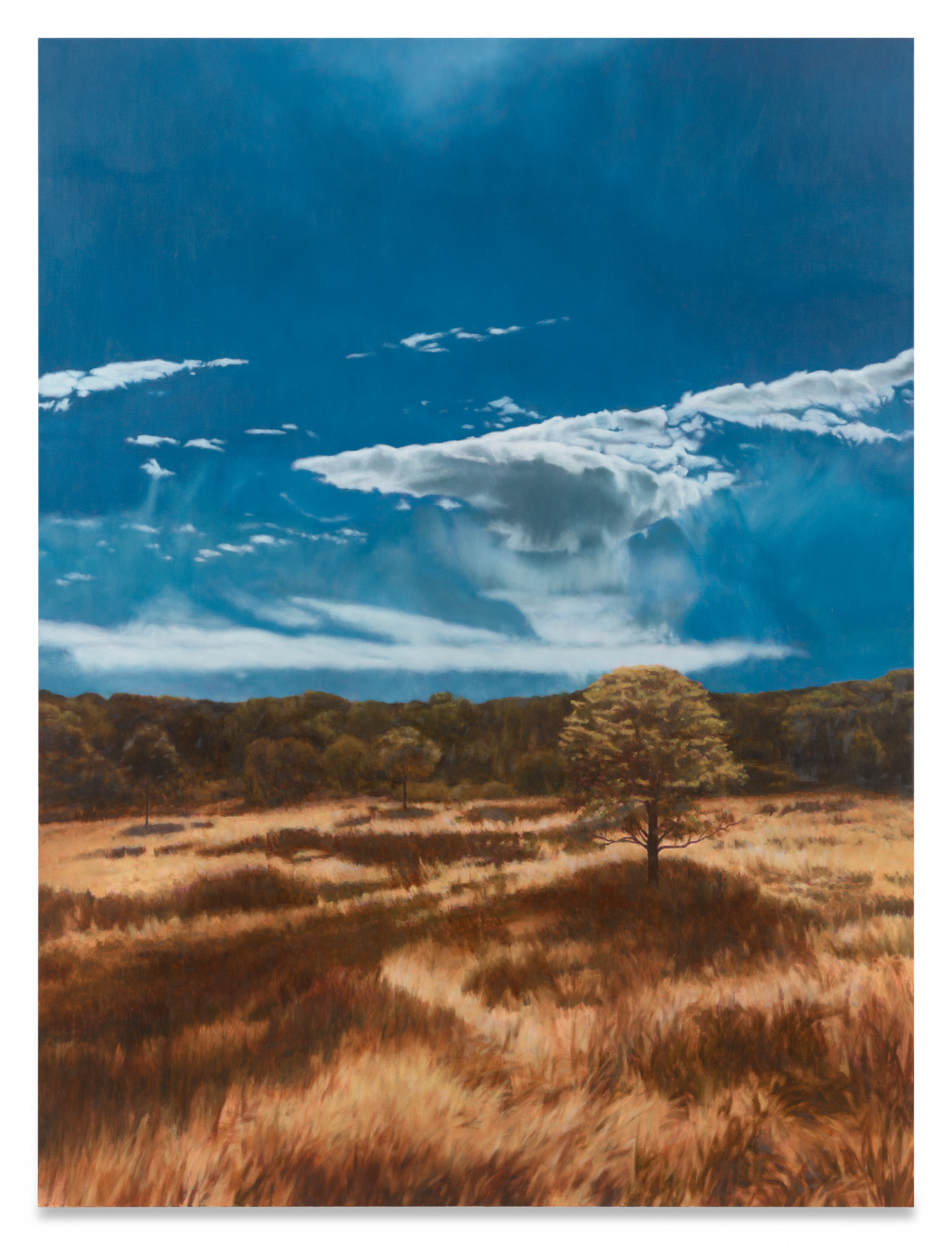
April Gornik, Just Before the Eclipse, 2025, Oil on linen,
80 × 60 inches.
Rail: Had you taken painting classes?
Gornik: Yes! All the basic classes. And when I was at the Cleveland Institute of Art, I was making mostly hard-edge, abstract paintings. At one point I got stuck on lemon yellow when I was printmaking, and it became one of the most interesting colors to me, because it has almost no substance, almost no weight. It reads “fast.” So I’d see what it could do in relationship to, say, black and gray. I still think of color characteristics like that, so I guess it was generative for me. And by the way, there’s a weird lemon yellow called “Nickel Yellow” that I started to work with in the smaller “white sky” paintings in this show, which I turned to to get an evanescent quality of white. I hadn’t used it for years, but it came back in those paintings.
Rail: That’s interesting. You sometimes talk about giving weight to your paintings. Is that about detail? Or density?
Gornik: It could be either or both, depending on the painting. It doesn’t necessarily confer more detail, or denser color. It’s painting-specific. It could be an amount of sky, or a certain way I want light to feel in reaction to other elements of a painting. It could be a direction that’s held in the composition that moves your eye around. There are a lot of movement considerations, compositional considerations, in the work.
Rail: Did you ever read Rudolf Arnheim? He had a whole thing about “visual weight,” and how something on the left was heavier than something on the right. He developed a whole psychology based on the hidden architecture of the frame.
Gornik: I know his name, but I don’t know Arnheim’s work. In Western culture, we read left-to-right, but I don’t subscribe to any kind of fixed rules in painting. I think every painting dictates different kinds of ways of becoming balanced and fluid according to an artist’s intentions. Then there’s some sort of détente that you try to reach between your intention for a painting and what it ends up needing to be or wanting to be, and that pushes you around more or less through the course of a painting. I draw out a painting with pencil before I begin, and usually use underpainting to try to feel out where I need to go with it. It’s a necessary part of a conversation I need to have with the object I’m making.
Rail: You’ve talked about how we identify paintings with our bodies, and we project ourselves into them, and I think the weight has something to do with that. Sometimes we feel like it’s too much over on this side—it’s out of balance—and you need to change things to create more equilibrium.
Gornik: For me it’s not even balancing, necessarily. It can be a way of making the composition dynamically out-of-balance, but the interior movement of the painting keeps it in check. Does that make sense?
Rail: That’s understandable. It is interesting that this first object you created, that became a painting, was about light. And coming back to your show, it’s clear that light has become such a central subject for you. One of your dealers told you that light was your protagonist. I liked that.
Gornik: Me too, and it’s true, and I think it’s always been from that first awkward landscape I made. Even when I started painting landscapes I wondered what was attracting me to them, and I just kept thinking, “Well, it’s about light.” Around that time somebody gave me a book about people who had near death experiences, and that had some answers for me, like maybe the mystery of why I made them was linked to mortality.
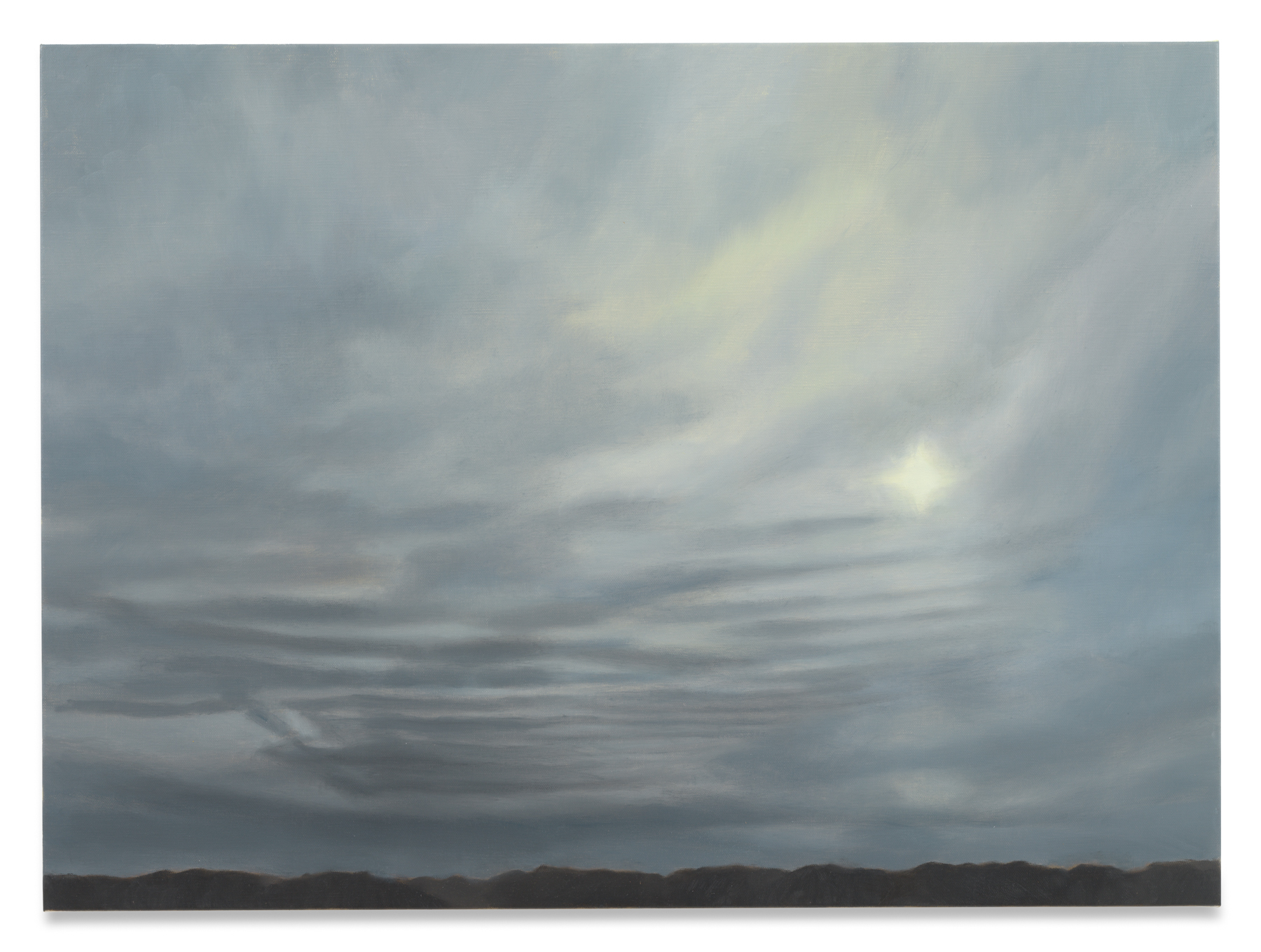
April Gornik, Schiele Winter Light, 2025, Oil on linen, 22 × 30 inches.
Rail: You like to seek out the limits.
Gornik: I know, I’m so far out on the edge. [Laughs] It’s true I’m always looking for the edge of an argument, or situation, or truth. So as to why light is important to me, I thought, maybe it’s mortality, it’s transience—so it’s death, too. And then now, there’s the fact that I’m calling my show Liminal States. Plus ça change. [Laughs]
Rail: There’s a geological aspect to landscape as well. It’s not just light—it’s also heavy stuff. It’s these ancient rocks that we’re looking at. Some artists really deal with that, like Paul Cezanne looking at Mont Sainte-Victoire. He was interested in that substantial thing. You seem to be more into the flux of nature, the light, the atmosphere, the water—things that are changeable.
Gornik: You’re right, because even though I paint a lot of landscapes where I quiet things down to near-stillness—which is a very grounded state—I’m fundamentally attracted to turbulence. It’s not always obvious subject matter, like a Leonardo da Vinci drawing of swirling clouds, but it’s in my work in the tension-and-release all art needs.
Rail: I’m thinking of your painting Schiele Winter Light (2025). That painting seems like it has a creased brow—as though the sky has these creases in it that you can run your fingers over. There’s a lot of tension in the surface of the paint. It’s a very quiet landscape, but is there some inner turbulence that you’re suppressing there?
Gornik: Not suppressing—I’m expressing it, in that the sky feels close, congested with tension. It’s quiet, like winter is quiet, but it’s constrained and anticipatory. In several of the small paintings I did of that group—the “white sky” paintings as I was thinking of them—I was reflecting on the winter light that Egon Schiele was so obsessed with, and was so good at rendering. I became interested in this, not so much because I love Schiele’s landscapes per se, but because there is a deep melancholy in Schiele’s work that I relate to profoundly, and in particular because my mother had recently passed away before I began making them. I was dealing with deep emotional turbulence. So that’s in that painting, and it’s a moment where it’s held and suspended and poised. So you are right to cite that painting in what I said about turbulence! More obviously, the big, blue painting World of Light (for GMH) (2026) is clearly about turbulence, but it’s also about flow. As a painter, you know that it’s always about tension and release. Everything is like that in terms of making a painting work—to give it animation. And it’s not about chaos for me, although it’s fine if it is chaotic for someone else. I do always want to invite personal interpretations of my work.
Rail: You certainly invite interpretation in one striking painting called Balance (2024), with the sky equally divided right in the middle of the horizon into opposing wedges of light and dark. But I’d rather talk about Just Before the Eclipse (2025)—a less bifurcated painting than that one.
Gornik: Well, there’s a story there, actually. In 2024, I went to see the total eclipse in Fort Worth, Texas, and beelined to their botanical garden to wait for it. It turned out to be profoundly and unexpectedly alarming. I truly felt the terror of the sublime in a whole new way, that was completely sensory and un-intellectual. That phrase came to mean something totally different for me after seeing it, because when the eclipse was full, I was literally afraid to look up at it. I felt an absolute animal fear, like I was functioning completely out of my amygdala. I felt my size in the universe, and I felt very small. I just don’t often feel like that.
So I thought: I have to do a painting about the eclipse somehow. I made image after image from photos I took, worked out several, and ordered a canvas for the most likely workable sketch. But then I just couldn’t start the painting. I wanted to start, but I did another smaller painting instead. And finally I had to realize that my sketches and ideas were just inadequate.
And then I found a very different photo I had taken of a beautiful field I walk in sometimes out here. I was fascinated with the sky’s imbalance, which was speaking to me, and I darkened and manipulated it. The field below the sky is from a different photo, and as I painted it, it developed a slow, swirling quality. It became a vertiginous anchor for the sky, and it had its own corresponding weight. It took a few months to paint it.
Then a few weeks after I’d finally finished it, I was looking at it, and I suddenly remembered that it was on the same canvas I had meant to use for the eclipse painting. And looking at the light in it, I also recognized that the light was like just before the eclipse began—a kind of dream light—because as the sun faded and the world darkened, there was also a weird kind of sparkle of what light was left at the same time the shadows were becoming so deep. So I realized I had made an eclipse painting. It was one of those weird and wonderful moments in the studio.
Rail: I’m curious to know more about your process. You’ve given me an idea of how intuitive it is. Could you say a little more? I know you make these smaller paintings, but they’re not sketches or studies to be realized at larger scale, right?
Gornik: Very early on, I wanted my work to have a visceral relationship to myself and to the viewer, and that meant that I had to make them the right size to be stood in front of and experienced physically. That was very important to me. I had pretty quickly sized up to painting on four-by-eight-foot sheets of plywood, but then I got frustrated because I needed to make a painting that was wider than that. So reluctantly, I began to paint on canvas. I loved painting on plywood, although it’s a terribly unstable surface, which I wasn’t thinking about at the time and didn’t care about. In 1979, I was still on the fence about being a “landscape painter.”
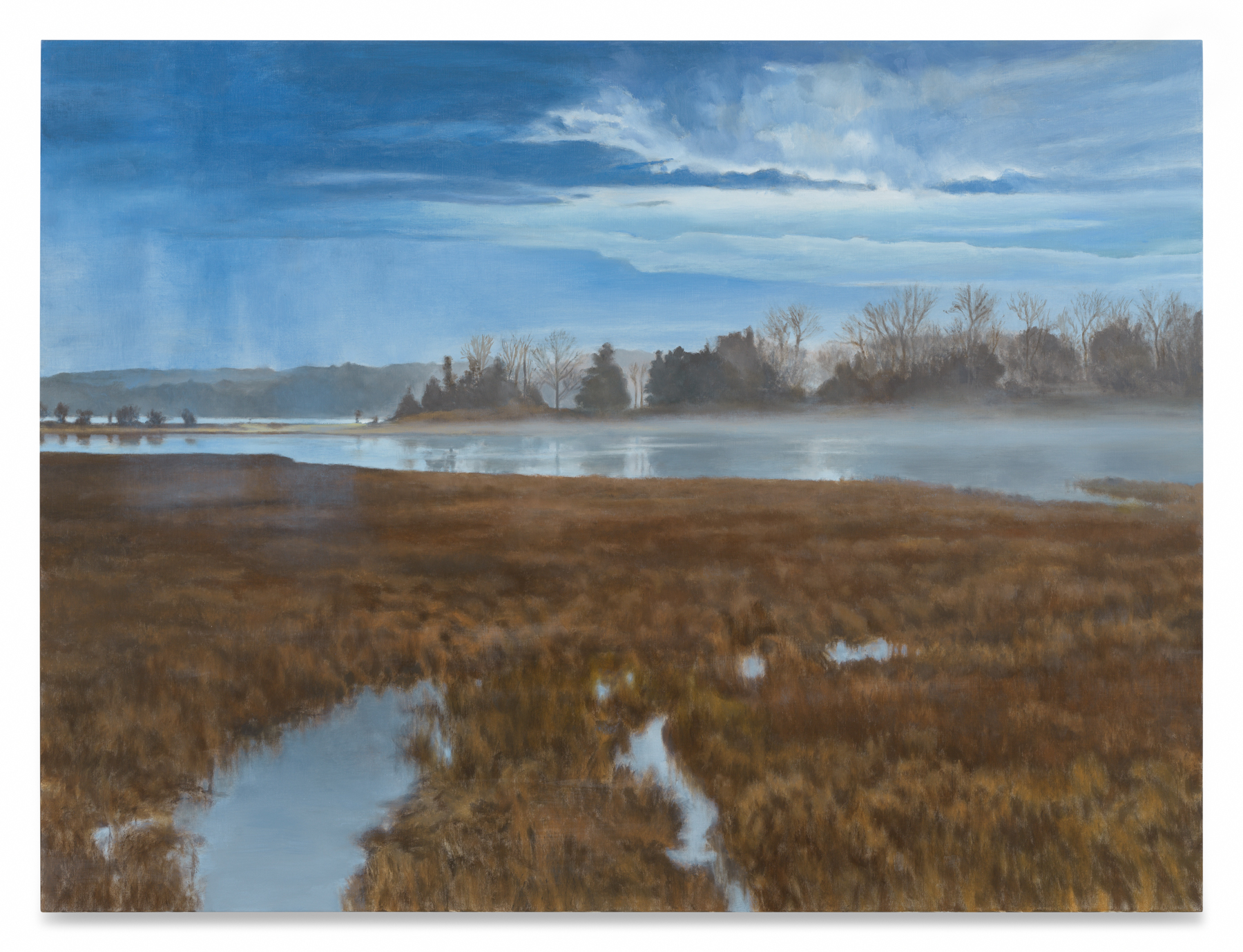
April Gornik, Annunciation (after da Massina), 2026, Oil on linen,
36 × 48 inches.
Rail: But it’s not like you’re going to scale up and reproduce the smaller paintings. In another conversation, you mentioned Gaston Bachelard’s idea that we adjust our size phenomenologically to “inhabit” a small painting—you seem to be saying that you use an internal sense of scale to determine the size of your painting. You experience differently sized paintings in different ways.
Gornik: I never start the smaller paintings as sketches for bigger ones, but occasionally I’ve had to make them bigger. For instance, the large painting that’s called Spirit Clouds 5 (2024) has all these different layers of color and a big reflection. It was made as a small painting, but after living with it I realized, “No, I have to make this bigger,” because I needed to feel it with my whole body—to feel that it was enveloping. I wanted to feel the pushing and pulling of the light against the darkness and the depthlessness of the reflection more physically.
Rail: How do you develop an image? You talk about underpainting, which goes back to older academic methods, but you’ve said in other places that you’re using collage and Photoshop—that you put collected images together to generate the image for the painting. I was thinking of it particularly in relation to your charcoal drawings, where you have the white and you’re working against the white of the page. With collage, it’s very different: you’re putting images on top of each other.
Gornik: Well, it’s a beautiful balance of modern and ancient technology, the computer and the paint and the charcoal sticks. [Laughs] In the charcoal drawings, the paper gives you light automatically; you don’t have to concoct it out of paint. You just have to not wreck it. Big difference. I started messing around with Photoshop in the mid-nineties when I was trying to be a more organized person, and it was very exciting to be able to play with it. It quickly became a sketch tool for me—great for collaging, because I can do it so quickly—and I’ve been working with it ever since. My impulses can keep up better.
But when I begin a drawing or painting, it’s similar. I have a sketch, but I need to feel out the composition and image by drawing, and as I do, I’m thinking about how I’m going to emphasize or limit aspects of the image. I can push or discard detail while I’m drawing something out, and also while doing an underpainting, which I usually do, often with pretty shocking, contrasting color. There’s also an irregularity to real nature that I can pull back out from a photo sketch, and it’s an asset because of the rich complexity that’s in nature’s irregularity. It’s something I can imitate from nature, but I can’t “grow” it the way nature can. And then there’s the point where the sketch has to just go away, which is different for each work.
Rail: Your work makes me think of Georgia O’Keeffe, and her relation to Alfred Stieglitz’s photography. At a time when everybody was trying to make photographs look like paintings, Stieglitz was trying to make highly rendered photographic images of things. He thought there was a sensuality and a beauty to that, and a personal quality. O’Keeffe picked up on some of that precision in her more abstract images. I know she’s not your favorite artist, but I thought—since you’re interested in light and dark, and photography in those early days was totally light and dark—you might find some common ground with their intentions as you try to translate light.
Gornik: You’re right: her work is often a little too overtly symbolic for me, although she did some paintings I’m crazy about. I’ve never loved Caspar David Friedrich’s symbolic ruined cathedrals, but Monk by the Sea is so, so great. I don’t want my work to be heavy with symbolism—although of course I’m inviting it, like every artist, since people always want to find meaning in art and will project into it in whatever way they need to.
Rail: I showed you some of Stieglitz’s “Equivalents,” and you responded favorably. They relate to your expanses of clouds and even include bits of landscape on the margins like yours, but they are symbolist rather than symbolic—they evoke associations but don’t have a particular reference, like how O’Keeffe’s skulls connote death. The British poet Charles Tomlinson, who was friends with William Carlos Williams (“no ideas but in things”) and went to visit O’Keeffe in New Mexico, talks about her “distanced vision”: the combination of strangeness and objectivity that she imposes on her subjects, with particular reference to her “Jack-in-the-Pulpit” series from the 1930s. He felt those paintings had that strange objectivity to them, like those things you say photography shows you that you wouldn’t have invented. He said he likes artists who preserve that strangeness, who “penetrate … while refusing to merge.”
Gornik: For me, nature is the ultimate “other,” and I want to keep it that way. I like that it stands apart from me. I am merged with it, of course, like it or not. And objectivity is not my goal. I totally relate to Steiglitz’s “Equivalents,” which I hadn’t realized are a series. Thanks again for that introduction! So my editing of my work is all subjectivity and projection.
Rail: It seems like you maintain a balance. That sort of editing leads me to another painting, Lightbound (2025), which unites various aspects of your work. It’s detailed, but it’s mysterious. You like dualities, and the horizon divides it horizontally, right in the middle, between sky and water. There are two circular bursts of light: one up in the clouds, and the other one seemingly reflected in the water, only it’s not really a reflection—it’s something else, a bit uncanny.
Gornik: That uncanny reflection gives the painting a different sense of depth, and weights the bottom. You can call it a reflection, but I think of it more as an echo or an opposition.
Rail: Can you talk a little more about that?
Gornik: Well, it contains certain kinds of metaphoric possibilities, because it’s a little abstracted, but it still connects with what it’s echoing in the sky. The black in it is too deep and exaggerated, so to me it’s kind of a drain or a whirlpool or a black hole appearing in the water.
Rail: It’s very symbolist to me. It definitely has a strange objectivity, and it makes me think that Lightbound could refer to our universal situation—how we’re stuck in this structure where every day the sun goes up and down. We’re bound in our orbit, you know, where we have to see that light.
Gornik: I wasn’t thinking of the title quite like that. I was thinking of the way that light holds both clouds on the top and the hole in the bottom in perpetual balance. It all has a slight spiral, moving ultra-slowly in place, for me. But I have to be honest: anything I’ve done that’s within the last year or two, I will not be able to fully explain. I never see everything in the work until later, if at all. Sometimes the work marks a moment of realization or revelation, but a lot of my work I’m still wondering about.
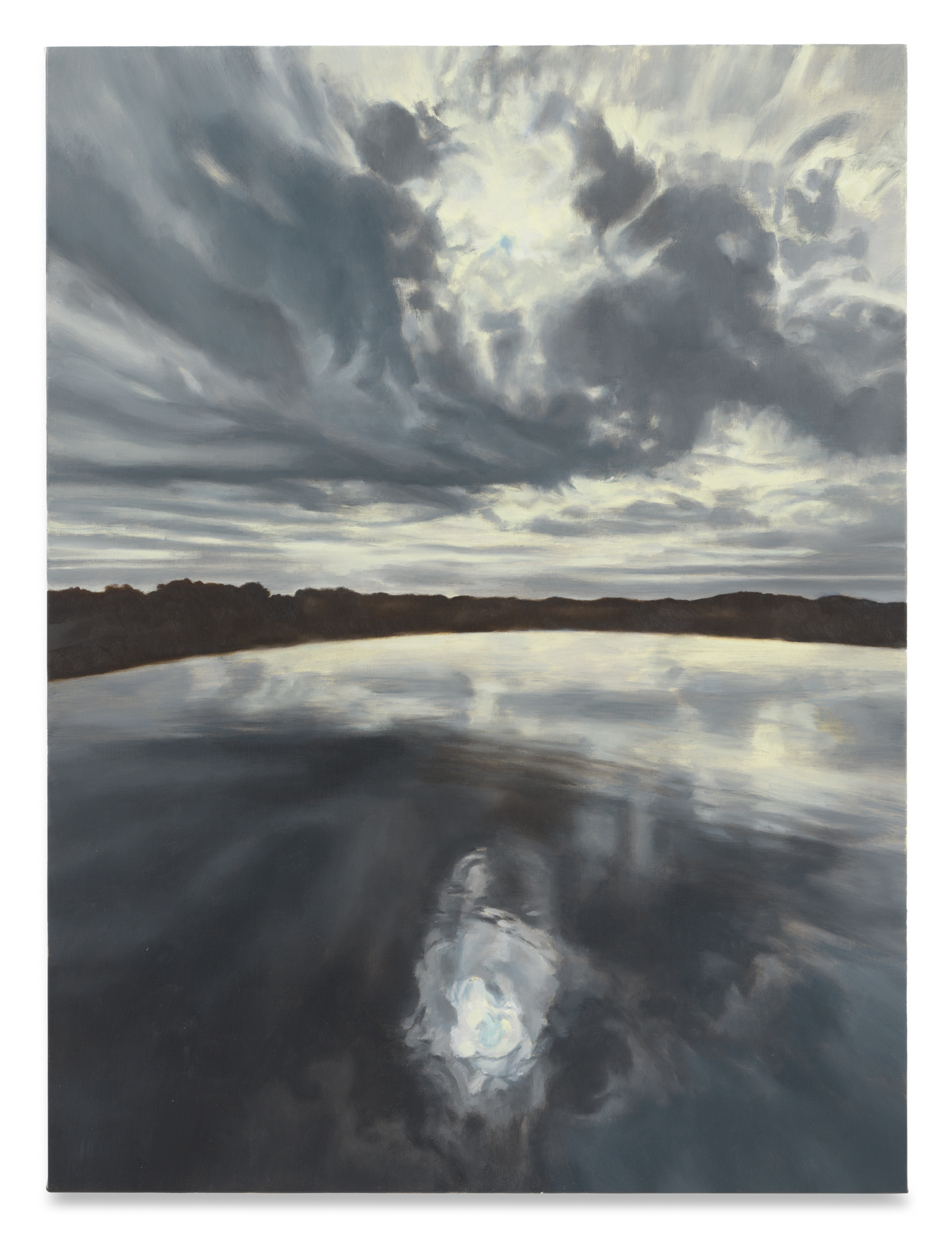
April Gornik, Lightbound, 2025, Oil on linen,
32 × 24 inches.
Rail: It’s a great example of how you adjust internal relationships to bind your landscapes together. But what about your Annunciation painting, dedicated to Antonello da Messina?
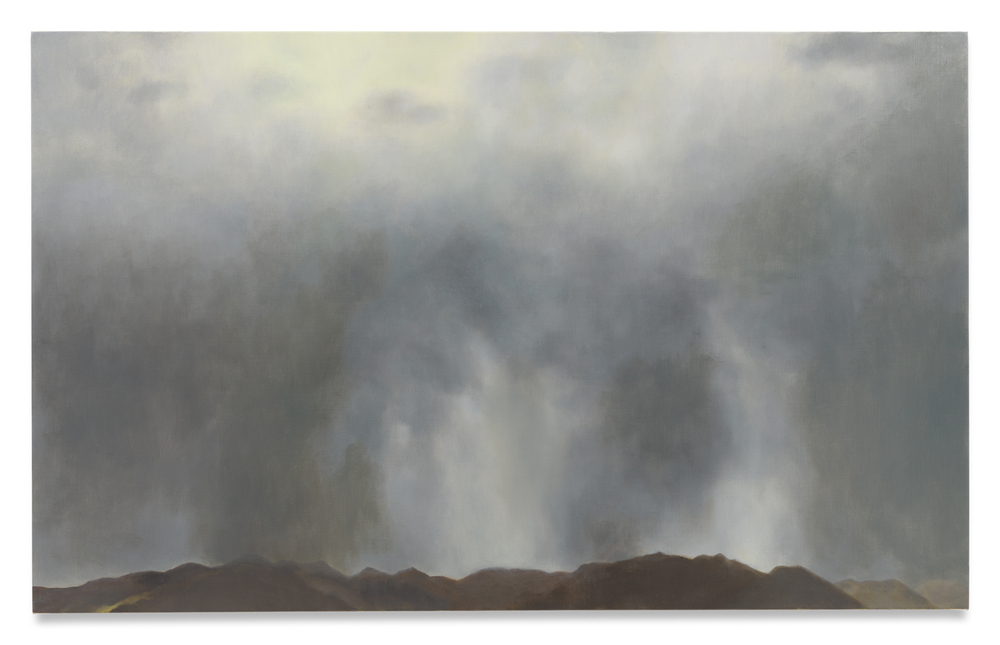
Gornik: Antonello da Messina did an Annunciation (Virgin Annunciate, ca. 1476) I saw about twenty years ago in Palermo that depicts a woman wearing a blue veil, and who has a plain, clear-eyed face—no gold halos. She’s alone at a lectern, and one hand is on her book and the other hand is slightly raised in front of her. She’s looking a little left of the viewer, like she’s focused on seeing or hearing something. That’s it. It’s the coolest, most abstract Annunciation anyone ever painted. As I was starting to make what became my Annunciation painting—I probably shouldn’t have called it that, but oh well, I was raised Catholic—I was horsing around with the photograph I was working from, and I started to see, or imagine, rain falling. It’s not in the photograph, but I imagined a presence of rain touching the ground, with a little light held within, or passing through it. It’s a modest painting, and I thought perhaps this is what da Messina was trying to do: make something quietly revelatory.
Rail: The light is softer, and it has a very particular—maybe we could say “poetic”—quality to it, very different from the more dramatic lighting of Lightbound.
Gornik: It is softer, more modest. Or stealthy. But it has its own strength, which resides in the fact that it’s quietly putting things in front of you that you wouldn’t necessarily think are important at first glance. It’s like everything is held in a super quiet moment, and it needs a little time. The glow within the rain sort of faces off the light in the sky that’s on the other side of the painting, and that literally connects the two. But I didn’t think of the da Messina painting until after I had finished it. It was again an entirely retroactive moment when I realized I’d painted something in common with that great Annunciation that I was so struck by.
Rail: So it was something that you were living with for a while, not necessarily thinking about. And then it kind of emerged.
Gornik: Exactly, a big surprise. Maybe the connection was lurking in the back of my mind, and then suddenly it was so obvious. Of course the Annunciation depicts a liminal moment, so maybe I was inclined to look for it unconsciously. Hard to parse. It’s part of the long meditation on liminal states that I’ve been obsessed with for the last few years. It’s a very personal thing, and I don’t expect viewers to have the same experience, but in honesty that’s where I have been coming from.
Rail: Well, for a religious person, the Annunciation is a moment that transforms the universe. And for you, that comes through in a different kind of light—through personal loss. It’s the antithesis of the eclipse painting, which gets very contrasty. This is more subtle.
Gornik: I don’t disagree, but if you’re looking at light before a shift, like an eclipse, or if you’re looking at a moment on a marsh where there’s light that kind of bisects something that’s barely there—they both are passages, or portals, or moments that are versions of similar dramas.
A moment can change the history of the world and your life can change with a moment. The gift comes from the way those experiences can be a glimpse of something that’s corporal and solid and as fundamental as death, and can simultaneously feel miraculous, or extraordinary, and spiritual, like a kind of a spiritual recognition. Or intimacy in immensity.
Rail: That’s very moving. In a related vein, could we talk about World of Light (for GMH) (2026), your painting dedicated to the poet Gerard Manley Hopkins, who was very religious.
Gornik: Hopkins has this phrase in his poem “God’s Grandeur” that describes light that “flame[s] out, like shining from shook foil.” I got very stuck on that phrase, and I wanted to try to achieve that in some way. I love that ferocious, righteous poem. And it took me a very long time to make that painting.
Rail: His images, and the way he makes language so alive—it’s great. He doesn’t just invoke religion, he embeds transformation in the words.
Gornik: So beautifully put! Yes, he’s amazing. And at the end, when he finally says the Holy Ghost is going to come and shelter the world with bright wings, it’s like, “How dare you be so immense!? And how dare you be so hopefully sure.” What a claim.
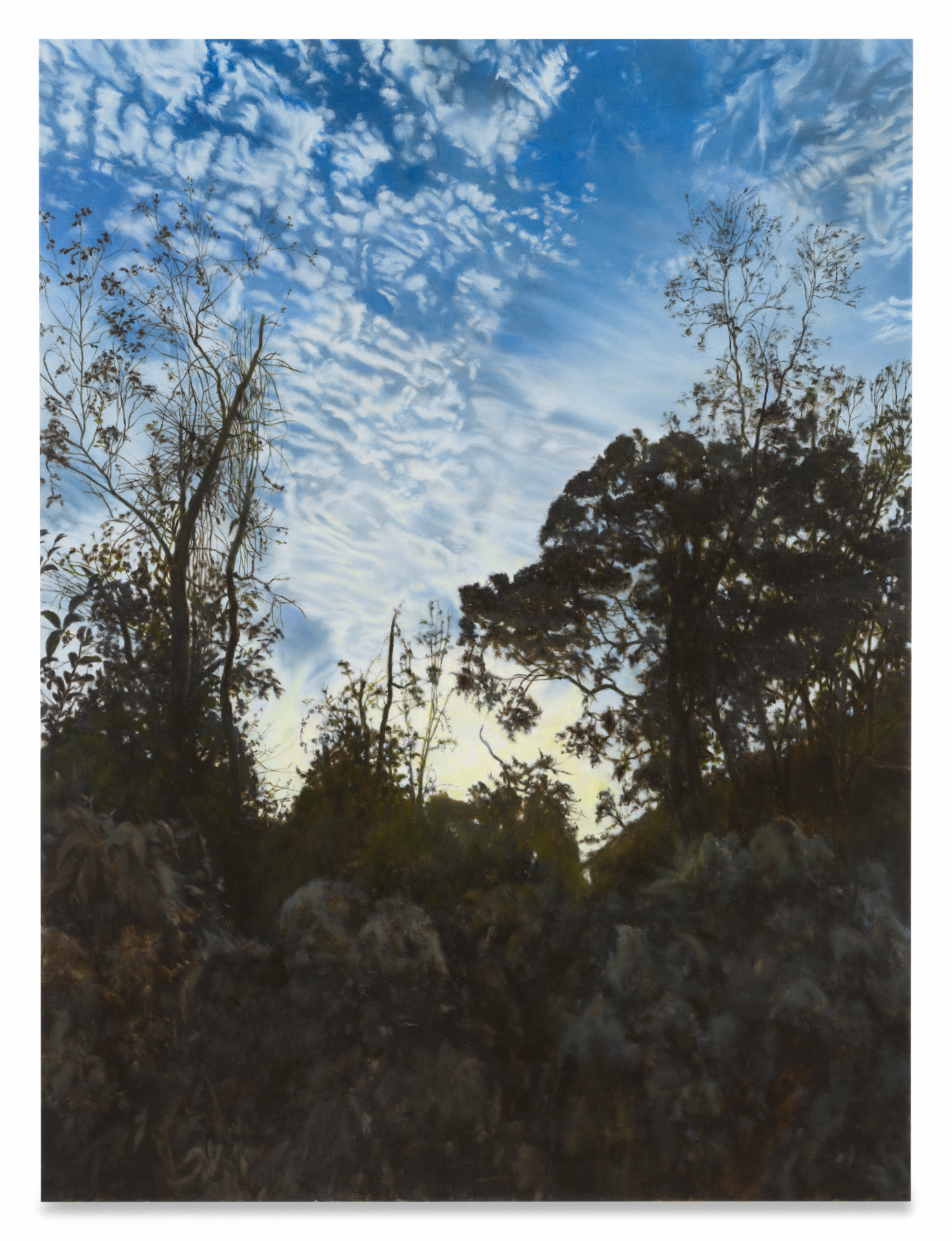
April Gornik, The Palm at the End of the Mind, 2026,
Oil on linen, 56 × 42 inches.
Rail: That’s a sort of celestial painting, but what about your painting that alludes to a more modest poem, Wallace Stevens’s “Of Mere Being”—The Palm at the End of the Mind (2026), which starts deep and stretches out for the sky.
Gornik: That painting is so odd for me, and I literally just finished it before this conversation, so I can’t be too clear about it. For one thing, it’s between large and small. The light in the sky pulls you hard towards itself, partly because you’re in a kind of a chasm of trees and shadows at the bottom.
I wanted the branches of the trees to tendril into the sky and kind of meld with it. The lit sky has the same kind of just barely constrained kinetic activity—a lot of it from color—that the branches do. Looking at branches with that much detail—I never wanted to paint that. But in this case I thought, “No, I have to.” I even went and looked at Schiele, especially his late landscapes, which have happier and healthier trees than his earlier ones, where the trees are often only a couple of teetering lines in the landscape that look like they’re about to collapse. In the later paintings he had patiently made those branches, using very little painting shorthand.
So I thought, “Okay, I have to try to do something using the reality of trees.” I wanted to make them feel brambly, but also graceful—something that you could get spun up in, and something the light would get trapped in. You can feel the light rise, but then the rest of the painting is also sort of coming up around you in a way that snares itself into the light, and then at the bottom everything becomes really dark. And there are some odd details in there, like abstractions of leaves and whatnot. So that piles up a bunch of weight at the bottom that lets the light move more aggressively away from it.
Rail: I’m looking forward to seeing it in person so I can begin to pick out all those details.
Gornik: You’ll see, some of it’s painted in quickly, wet-on-wet. I wanted just enough detail to emerge that you can start to imagine references to a darker world in the ground below. Anyway, the poem “Of Mere Being” started to come up for me towards the end of making that painting, and the title is his first line. Wallace Stevens created one of the great evocations of being in that poem. It’s shocking and total and the whole poem feels like a portal to accepting being. Also the rising and falling in that poem goes with the painting’s behavior. So you thought you knew something about what you were doing—maybe had a hint of purpose as you began the painting—but then you realize you’ll never completely know, because it’s just what it is.
Rail: “Mere being,” indeed. I think our conversation has led us to an observation the painter/critic Robert Berlind made in an essay on your drawings, that poetry is as useful a reference to understanding painting as theory or art history—an implicit response to early critics like those in Nova Scotia who forbade painting, calling representation “deadly,” whereas you animate it with light and breath. But just to cover the full range of your references, we should mention Specter Lights (2024), which alludes to music. You dedicate it to Neko Case.
Gornik: First, I have to send a little love and gratitude posthumously to Bob Berlind, who introduced me to Gaston Bachelard and gave me The Poetics of Space—one of the biggest gifts I’ve ever received—‚which gave me so much ammo for trying to understand how art, poetry, and my work “work.” Using poetry to explain poetry, as Poetics of Space does, is so brilliant. As I was painting Specter Lights, I got a Neko Case song called “A Widow’s Toast” stuck in my head, which has a kind of animal wildness that she always expresses in her music (and lyrics), and I relate to that. I mean, I principally listen to Johann Sebastian Bach more than anybody else, but sometimes you need rock-and-roll.
