
April Gornik
EXHIBITION REVIEW: APRIL GORNIK’S UNSETTLED LANDSCAPES
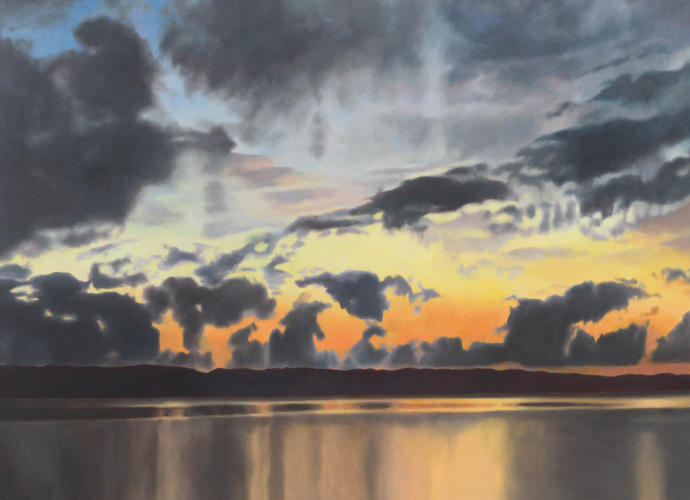
In “Liminal States,” Miles McEnery Gallery presented recent paintings by April Gornik, juxtaposing five of her familiar large-scaled canvases with seven much smaller paintings, depicting fragments of landscape against vast, roiling skies. Her unsettling work is based upon her observations of nature and the cosmos. Its mystery comes not from the replication of superficial appearances but rather from the fusion of precise draftsmanship and painterly rendering, which involves complex modulations in brushwork, texture, and chromatic layering.
“As I go along,” she told me, “I am being corrected by the painting.” Dissatisfaction with faulty brushstrokes prompts her to adjust and repaint, resulting an unpredictable gestalt that “feels weirdly familiar” in the painting’s final stages. Sometimes, she is seems to be making two different paintings in one. In Spirit Clouds, example, the turbulent sky resembles that of 17th-century Dutch painter Jacob van Ruisdael, while the watery lower section evokes Morris Louis’s mid-century Veil paintings.
Gornik, who lives near Sag Harbor, carries into Annunciation (after da Massina) familiarity with the climate and coastal landscape. Echoing the greyed ultramarine and golden yellow palette in Antonello da Massina’s eponymous early Renaissance portrait, Gornik’s Annunciation explores the dynamic edges between land and water. Narrowing slivers guide the eye from foreground to background, while misty columns of light penetrate the pewter-toned water. Gornik conjures a bog with umber and ochre-colored grasses surmounted by cirrus clouds in a cobalt-blue sky. Without visual fanfare or didacticism, she lets us see and feel how these liminal landscapes serve as ecological filters.

Annunciation (after da Massina), 2026, Oil on linen, 36 x 48 inches.
In World of Light (for GMH), a tour de force, the chromatic vocabulary of blues is astonishing, emerging from strident red or orange underpainting made to “simmer’ by the final layers of color. Gornik works with many blue pigments. Cobalt blue is a favored base color, tempered by mixing. Mars violet, which she considers red, and exotic colors like Fanchon Red are standard fare. Gornik usually mixes colors without adding mediums but later glazes the oil-on-linen paintings with medium and mineral spirits to pull the color back up to the surface. This technique produces a textural sheen – softly reflective and even iridescent in some areas, cottony or velvety in others.
Aficionados of Charles Burchfield (1893–1967) – like Gornik, born in Ohio – may find a familiar motif in Gornik’s White Sky. His Conventions of Abstract Thoughts – visual symbols for universal emotional states – appear in many of his transcendental watercolors. A double-scallop shape representing what he called “hypnotic intensity” is present in his 1952 watercolor Midsummer Afternoon, owned by the Vero Beach Museum of Art. Perhaps Gornik had this in mind when she teased out two M-shaped forms in the rivulet of burnished white clouds that reflect the rolling silhouette of mountains below.

White Sky 1, 2024, Oil on linen, 24 x 36 inches.
Gornik’s work of the past three decades has steepened the trajectory of landscape painting and energized its reinvention across in contemporary American art by artists such as Renate Aller, the late Joellyn Duesberry (1944–2016), Richard Kooyman, James Lavadour, and Melanie Parke. In the habitats depicted in her paintings, Gornik isolates the observed world and showcases the sheer physicality of seeing and thinking.
Rebecca Allan —

New York, NY: Miles McEnery Gallery,
“April Gornik: Liminal States,” 2 April - 9 May 2026.
