Bo Bartlett

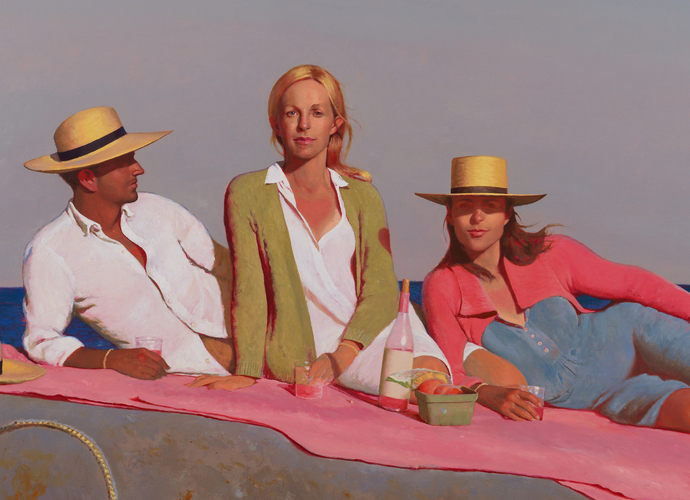
Halloween, 2016, Oil on linen, 82 x 100 inches, 208.3 x 254 cm.
His work reminds us that painting can still surprise, move, and make us think. So yes, laugh at his “provincialism,” mock his attachment to figuration, but don’t forget that art history is full of artists misunderstood in their lifetime because they refused to follow trends. Bo Bartlett may well be one of them, a painter who chose to stay true to his vision rather thancourt the art market’s favor.
And if you still think figurative painting is dead, I suggest you visit one of his exhibitions. You might be surprised to discover it’s very much alive and still has much to say about our time and ourselves. As Nietzsche said, “We have art in order not to die of the truth.” Bartlett’s paintings offer us just that: a truth that doesn’t kill us but helps us better understand our world and our place within it.
Hervé Lancelin —

Halloween, 2016, Oil on linen, 82 x 100 inches, 208.3 x 254 cm.
His characters are often frozen in poses reminiscent of 19th-century tableaux vivants, but with a troubling psychological dimension that instead evokes the photographs of Gregory Crewdson. This tension between pictorial tradition and psychological modernity creates what Friedrich Nietzsche would have called an “Apollonian-Dionysian effect,” a façade of order and harmony barely concealing an underlying chaos.
Bartlett’s genius is in understanding that to depict contemporary America, paradoxically, he had to move away from photographic realism. His paintings are hyperrealistic in technique but surreal in emotional impact. This is what Maurice Merleau-Ponty called “perceptual faith,” the ability of painting to make us see the world differently, to make us doubt what wethink we know.
Take his Lacunae series, which explores gaps between established religions and secular worlds. These paintings are not simple illustrations of theological concepts but visual explorations of what Giorgio Agamben would call the “sacred profane,” those moments when the divine erupts into the everyday in disturbing and inexplicable ways.
His technique is impeccable, sure, but it’s his conceptual audacity that truly sets him apart. He dares to paint monumental scenes at a time when figurative painting is deemed outdated by the art establishment. He persists in believing in painting’s ability to tell complex stories when the trend is toward minimalist installations and ephemeral performances.
What’s remarkable about Bartlett is that he creates images that operate on multiple levels simultaneously. His paintings are accessible at first glance, you can simply appreciate their formal beauty and technical mastery. But they also contain deeper layers of meaning, historical and cultural references that enrich their interpretation without ever making them inaccessible.
His work poses a fundamental question: how to paint America today? How to represent a deeply divided nation without resorting to clichés or propaganda? His answer is to create what Jacques Derrida would call “specters,” images that haunt our present by simultaneously invoking the past and the future.
Bartlett’s strength is in creating a style that transcends easy oppositions between figuration and abstraction, tradition and modernity. He paints works that are both classical in form and profoundly contemporary in content. This is what Arthur Danto would call “post-historicalart,” art that freely draws on all traditions while remaining resolutely of its time.
His grand narrative compositions function as what Umberto Eco would term “open works,” they suggest stories without imposing them, leaving the viewer free to imagine their own interpretations. This is especially evident in works like Homeland, where historical references blend with contemporary elements to create a complex and ambiguous temporality.
Bartlett dares to take his time, develop ideas over several years, and create works thatdemand slow, attentive contemplation. He rejects the ease of spectacular effects in favor of what Susan Sontag would call an “erotics of art,” an approach that engages all our senses and intellect.
Bartlett’s courage lies in persisting with his vision when everyone told him narrative painting was dead. He continued to believe in figurative art’s ability to speak to our era, to create what Walter Benjamin called “dialectical images,” images that condense the contradictions of our time.